
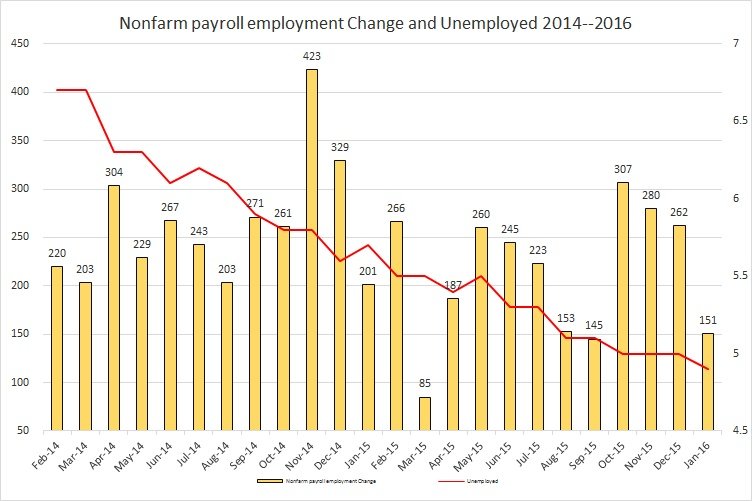
After presenting strong reports in the past several months, the U.S. non-farm payroll showed a lower than expected headline number: Only 151K jobs were added in January – the lowest gain since September. The ADP report estimated 205K jobs were added; the market expected 189K for January. The growth in wages was set at 2.5% even though wages didn’t budge on a month over month rate. The main sectors that expanded were in retail trade, food services and drinking places, health care, and manufacturing; employment fell in private educational services, transportation and warehousing, and mining. The rate of unemployment inched down to 4.9%. The U.S. dollar is rising against other majors; gold and silver are also slightly up. Let’s take a closer look at this report:
The U6 unemployment measurement, a broader measure of unemployment, was flat at 9.9%. In terms of revisions, there was a total upward revision of -2K for December and November combined – in which one canceled the other out.
Source: BLS
In January, the rate of U.S. unemployment was 0.6 percent points below the rate recorded in January 2014.
The number of unemployed persons also (7.791 million) fell by 113K in January compared to the preceding month. The civilian labor force rose again by 502K. So there was a gain in number of people participating in the labor force and decline in the number of unemployed. Thus, the participation rate edged up again to 62.7%.
Finally, wages grew in January compared to December – the hourly earnings reached $25.39 per hour — a gain of 12 cent or 0.5%; wages rose by an annual gain of 2.5%, year on year.
Bottom line
The recent NFP report showed a mixed bag: Wages remain up, unemployment slipped again and participation rate edged up. But number of added jobs wasn’t high and U6 remains high. Nonetheless, the NFP wasn’t too bad. It’s actually in line with a tighter labor market: Slower growth in jobs and higher wages. If wages keep rising, this could suggest the U.S. labor market is still recovering.
For further reading: